
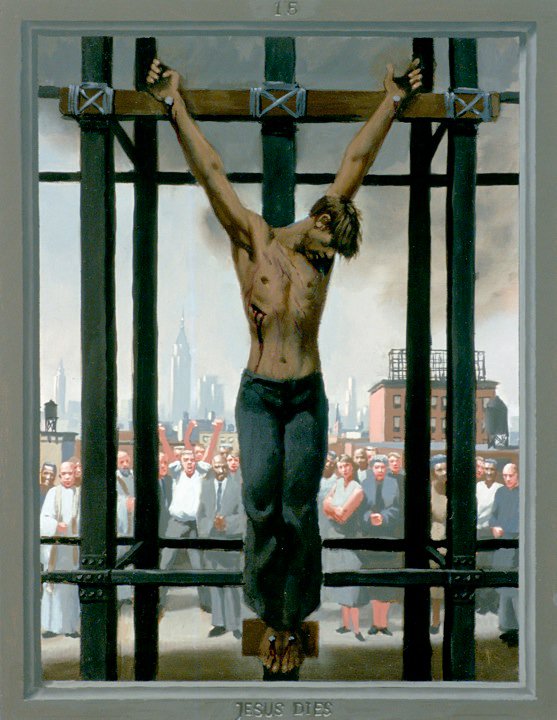
Doug Blanchard, an artist and Episcopalian and Kittredge Cherry collaborated on a new book of the Way of the Cross. The publicity around the publication has evoked praise and controversy:
From IJReview
There have been plenty of contentious and/or inflammatory artistic depictions of Jesus Christ over the years. One of the most recent comes from a book published in July, titled “Passion of Christ: A Gay Vision.”
The book contains two dozen paintings by artist and “very agnostic believer,” Doug Blanchard, with text written by Kittredge Cherry. Cherry calls herself a “lesbian Christian author and art historian.”
The series of paintings, which appear to be loosely modeled after the Catholic Church’s Stations of the Cross, tells the story of the Passion of Christ using images of modern people – the most notable one being the portrayal of Jesus as a gay man: From one commenter:
“I found the paintings and idea to be beautiful and refreshing… Personally, I do believe that if Christ was to appear in the U.S.A. today, he would be killed for his radical support of caring for the poor, the orphans, the homeless, acceptance of all.”
From Huffington Post where the discussion turned into one of the most commented stories they have published:
The contemporary queer Christ figure is persecuted, killed and rises again in the 24 paintings by New York artist Doug Blanchard. A surprisingly diverse group of friends join the gay Jesus on a journey from suffering to freedom.
Right-wing Christians denounced us as “blasphemers” and condemned our book as an “abomination,” “disgusting” and “an outrage to mock Christ in this manner.” Facebook canceled ads for the book because it was too “shocking.” When the LGBT community protested, the social media company reversed its decision and “resurrected” the ad. LGBT Christian visions are important now because conservatives are using religion to justify discrimination against queer people. Whenever anyone commits violence against another, Christ is crucified again — including when LGBT people are attacked or killed because of who they are.
Every group envisions Christ in their own image from their own context, and now there is a gay vision of Jesus, shaped by the political, economic and cultural forces of our time. LGBT people often identify with the hurt and humiliation that Jesus experienced on the cross.
From the book trailer:
posted by Ann Fontaine